How does Chinese medicine look at period pain?
Period pain isn't the same for everyone. For some it's a sharp pain that starts the day before bleeding, for others a dull ache that lasts several days, and for some it eases with warmth or gets worse with it. In Chinese medicine these differences matter, because they guide the treatment.
In our first session I'll ask about the length of your cycle, how heavy the bleeding is and its color, what happens in the days before, and about your sleep, digestion and mood. I also check your pulse and tongue. From all of this we build a treatment that fits your body, rather than one protocol for everyone.
What happens in a treatment?
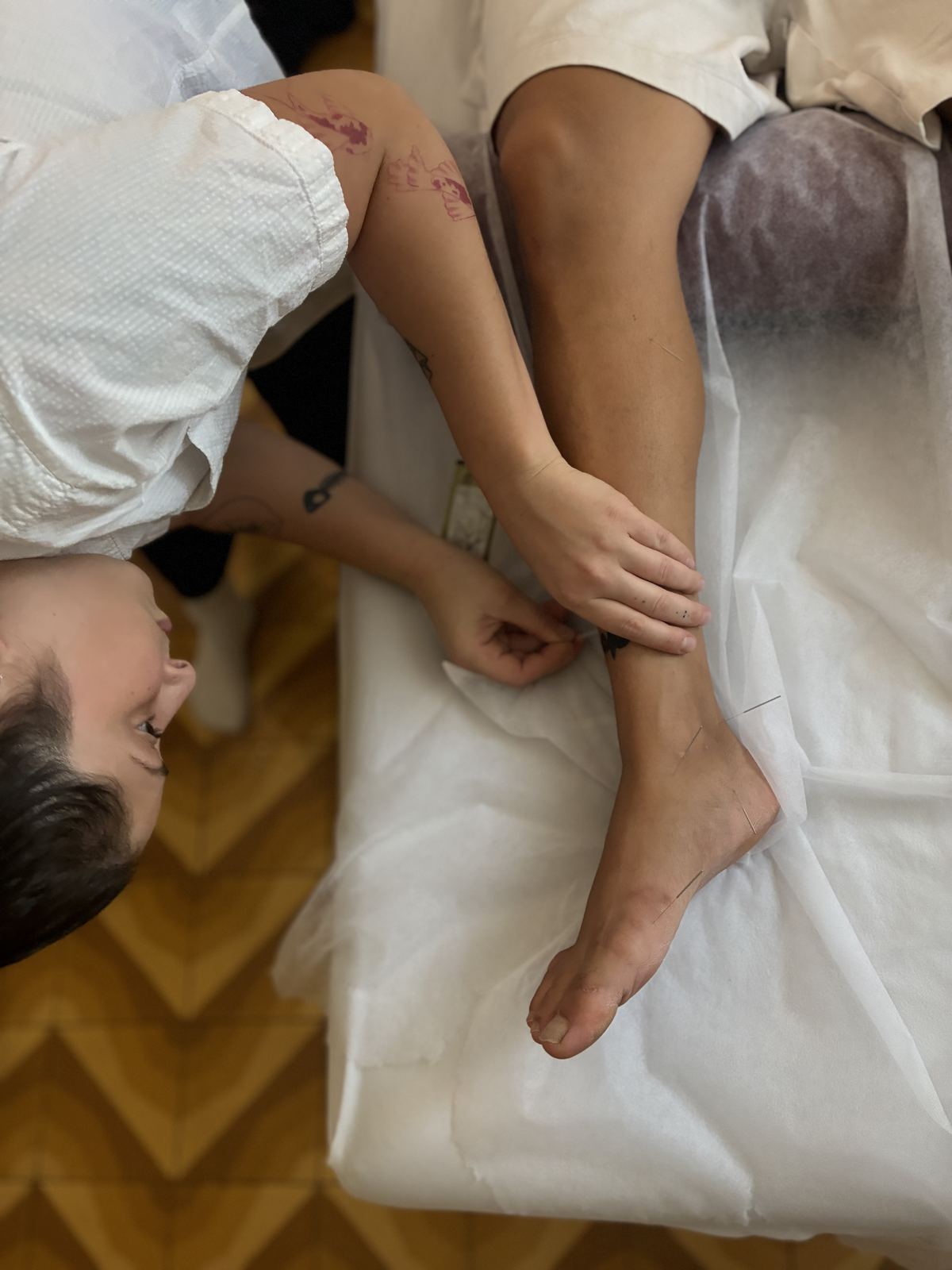
- Acupuncture at points on the lower abdomen, the legs and around the ankle. Some of these points have been used for period pain in Chinese medicine for centuries.
- Moxa, gentle warming of the lower abdomen and of points on the legs, especially when the pain eases with a hot water bottle.
- Herbal medicine in a personal formula that continues the treatment at home between sessions.
When in my cycle should I come in?
I usually recommend one session a week, with a focus on the week before your period. When the pain is especially strong, you can also come in on the first or second day. After three cycles we stop and look together at what has changed.
What does the research say?
A Cochrane review published in 2016 looked at the studies on acupuncture and acupressure for period pain. Some studies found less pain, but most were small and of low quality, so the conclusion was that there isn't yet enough evidence to say whether the treatment works. I'd rather say this plainly before we start.
Source: Smith et al., Acupuncture for dysmenorrhoea, Cochrane Database of Systematic Reviews, 2016.
When should I see a gynecologist?
Strong period pain isn't something you just have to put up with. Get a gynecological check-up if:
- The pain gets worse from year to year, or doesn't ease with painkillers.
- The bleeding is very heavy, or you bleed between periods.
- You have pain during sex, or pelvic pain outside your period.
- The pain started suddenly after years without it.
These can be signs of endometriosis or other conditions that are important to diagnose. Chinese medicine can be used alongside that medical follow-up.
Questions
Can I combine this with the pill or with painkillers?
Yes. Tell me about any medication or contraceptive pill you take, especially if we use herbs, so I can adapt the formula safely.
Is this suitable for endometriosis?
Chinese medicine can support treatment for endometriosis, alongside your gynecological care and not instead of it. The diagnosis and follow-up should stay with your doctor.
How long until I see a change?
We usually give treatment three cycles, because every cycle looks a little different. If nothing has changed after three cycles, we'll talk about it honestly.
Want to see if this is right for you?
Send me a few words on WhatsApp about what brings you in, and I'll get back to you to find a time that works. Sessions can be in English or Hebrew.